Financial Statement Audit Checklist Guidance for Businesses and Account Teams

Comprehensive Financial Statement Audit Checklist: Essential Guidance for Businesses and Accounting Teams
In today’s complex business environment, a financial statement audit checklist is more than a regulatory requirement—it’s a strategic tool that builds credibility with investors, lenders, and stakeholders. For businesses and accounting teams, preparing effectively can reduce stress, minimize findings, and uncover valuable insights into operational efficiency. Whether you operate under GAAP, IFRS, or local standards like Ind AS in India, a well-executed audit ensures accuracy, compliance, and transparency.
This 800-word guide provides a practical checklist tailored for business owners, CFOs, and accounting professionals. Follow these steps to streamline the process, avoid common pitfalls, and turn your audit into a growth opportunity.
Why Financial Statement Audits Matter
Audits verify that your balance sheet, income statement, cash flow statement, and notes to accounts present a true and fair view. They assess internal controls, detect fraud risks, and confirm adherence to accounting principles. For small and medium enterprises (SMEs), a clean audit report can unlock better financing terms. Larger firms use it to satisfy stock exchange or regulatory demands.
Skipping preparation leads to delays, higher fees, and qualified opinions. Proactive teams treat audits as a year-round discipline rather than a year-end scramble.

Pre-Audit Preparation Checklist: Get Your House in Order
Start three to six months before the audit date. Strong preparation cuts fieldwork time by up to 30 percent.
- Organize core financial records: Maintain an updated general ledger, trial balance, and supporting schedules for every account. Reconcile bank statements, credit cards, and loan accounts monthly.
- Review internal controls: Document policies for cash handling, revenue recognition, inventory valuation, and expense approvals. Test key controls yourself before the auditor arrives.
- Gather transaction support: Collect invoices, contracts, bank confirmations, fixed asset registers, payroll registers, and tax filings. Digitize everything for quick sharing via secure portals.
- Perform account reconciliations: Verify accounts receivable aging, inventory counts, prepaid expenses, and accrued liabilities. Resolve discrepancies early.
- Update accounting policies: Ensure consistency with current standards. Note any changes in estimates or methods.
- Prepare management representations: Draft letters confirming no undisclosed liabilities or subsequent events.
- Conduct a self-review: Run analytical procedures—compare current vs. prior year ratios (gross margin, current ratio, debt-to-equity). Flag unusual fluctuations.
Use a shared checklist dashboard so team members track progress. Assign ownership: one person for receivables, another for fixed assets.

Key Areas to Focus During the Audit
When auditors arrive, your accounting team becomes the primary point of contact. Stay organized and responsive.
- Cash and cash equivalents: Provide bank confirmations and reconcile petty cash.
- Revenue and receivables: Support cut-off testing with shipping documents and customer confirmations.
- Inventory and cost of goods sold: Facilitate physical counts and valuation testing.
- Property, plant, and equipment: Share depreciation schedules and capital expenditure approvals.
- Liabilities and contingencies: Disclose loans, leases, warranties, and legal claims.
- Equity and related-party transactions: Document shareholder contributions and inter-company balances.
Encourage open communication. Schedule daily status meetings and respond to queries within 24 hours. Train junior staff on audit etiquette—never alter documents after the cutoff date.
The Audit Process Step-by-Step
Understanding the flow helps teams anticipate requests and timelines.
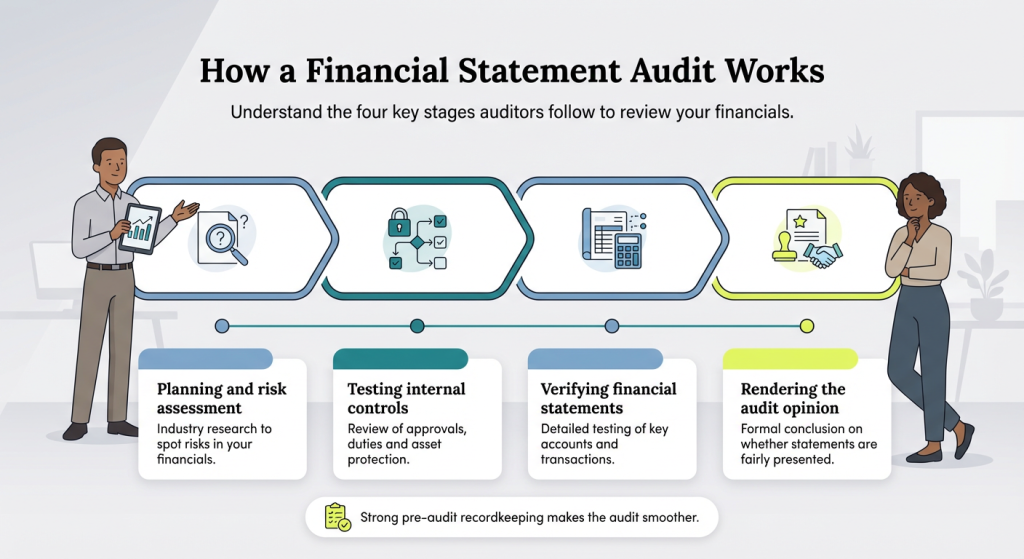
The process typically includes four stages: planning and risk assessment, testing internal controls, substantive testing of balances and transactions, and issuing the audit opinion. Fieldwork lasts 2–6 weeks, depending on company size. Expect walkthroughs, sampling, and analytical reviews.
Reviewing Sample Financial Statements
Visualize what auditors examine. A clean balance sheet shows matched assets and liabilities with proper classifications.

Study your own statements against this example. Ensure footnotes explain significant accounting policies, estimates, and contingencies.
Post-Audit Actions and Best Practices
Once the draft report arrives, review the management letter points carefully. Address internal control deficiencies immediately—implement automated reconciliations or segregation-of-duties improvements.
Update your permanent audit file with new templates. Schedule a lessons-learned debrief with your team and external auditors. Consider rotating auditors every 5–7 years for fresh perspectives.
Pro tips for accounting teams:
- Leverage cloud accounting software for real-time access.
- Train staff annually on fraud awareness and ethical standards.
- Budget 1–2 percent of revenue for audit fees and preparation time.
- For Indian businesses, align with MCA filing deadlines and ROC compliance.
Conclusion: Turn Audits into Advantages
A disciplined financial statement audit checklist transforms a mandatory exercise into a competitive edge. Businesses that prepare thoroughly enjoy faster closings, stronger stakeholder trust, and fewer surprises. Accounting teams gain deeper business knowledge and reduce burnout.
Start building your checklist today. Review records monthly, test controls quarterly, and engage early with your auditor. With these steps, your next audit will run smoothly, delivering not just compliance—but confidence and clarity for sustainable growth.
Informative article on Financial Audits. Regular audits are essential for transparency, compliance, and business growth. Corpally offers expert guidance and practical support—explore cpally.com for reliable audit and compliance solutions.
ReplyDelete